

Hormone Tracking for Women
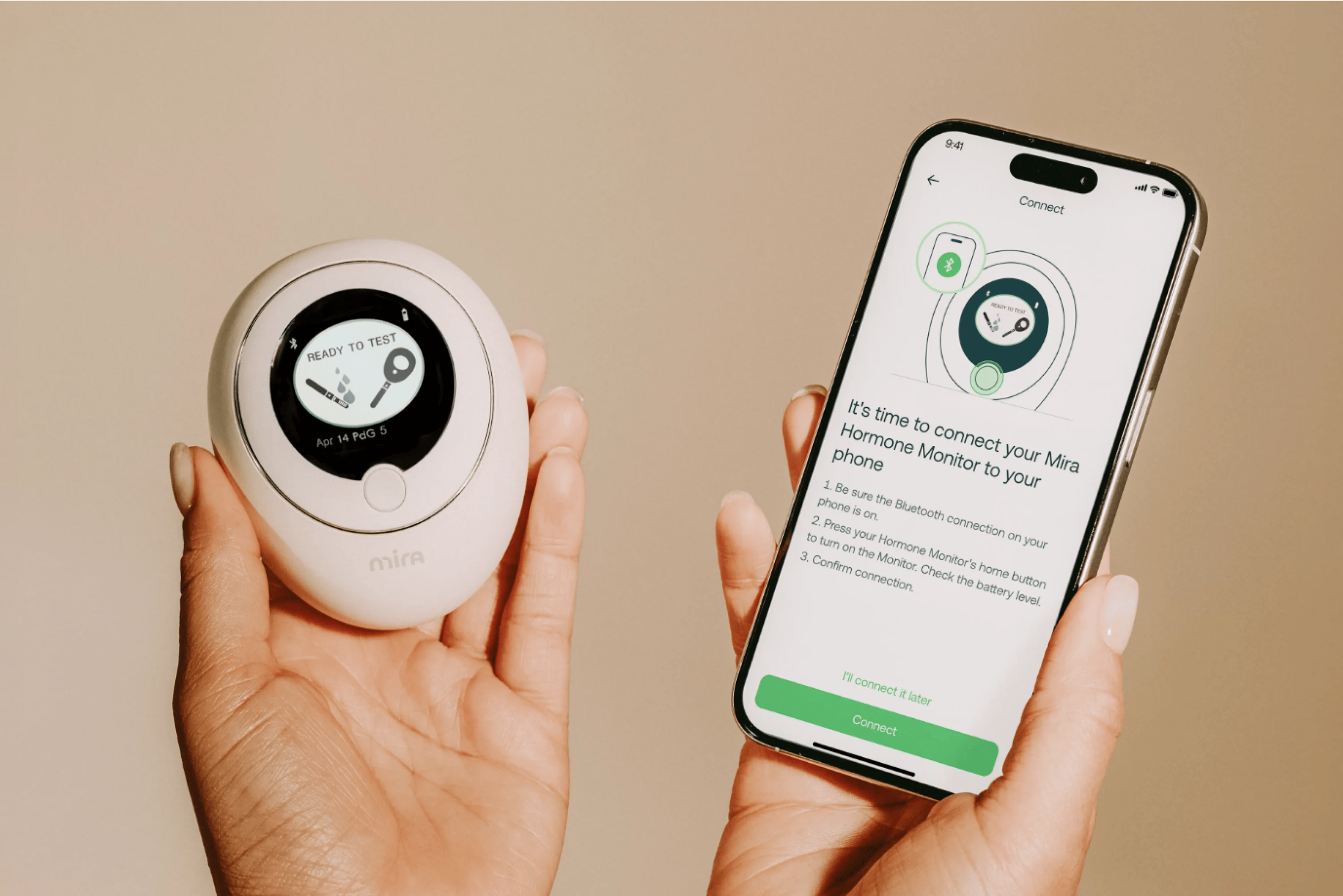
What is Mira hormone tracking, and how is it different from a hormone blood test?
A standard hormone blood test captures your hormone health in one moment of time. Hormone tracking, using at-home urine testing across your cycle, captures a hormone pattern instead. You can observe how your FSH, oestrogen, LH and progesterone actually rise and fall day by day, rather than a single figure that may or may not have landed on a meaningful day.
That distinction matters because hormones are inherently rhythmic. A "normal" result on the wrong day can miss a real problem, and an "abnormal" result on the wrong day can look worse than it actually is. Tracking across a full cycle removes that guesswork.
How does at-home hormone testing work?
A single blood draw only gives you one number, from one moment, on one day of your cycle. But your hormones don't stay still like that. They rise and fall throughout the day and shift across your cycle, and that movement is often where the real answers are hiding.
At-home hormone testing like Mira takes a different approach. Instead of one blood draw, you test daily using urine samples, which are read by a small device that connects to an app that measures your hormone levels and tracks the pattern over the entire course of your cycle.
This kind of tracking can help with:
Confirming ovulation, and when it actually happens
Understanding your fertile window with more precision than cycle apps or calendar-based methods
Spotting cycle irregularities that a single test would miss entirely
Monitoring hormonal changes during perimenopause
Building a genuine, personalised picture of your cycle rather than a generic one
Why I use Mira specifically
I recommend the Mira hormone monitor and app for convenience as much as for reliability. It uses at-home urine tests rather than blood draws to measure your actual LH, oestrogen, progesterone, and FSH levels daily across your cycle, giving you real, quantified numbers and in-app feedback as your hormones shift, rather than a single snapshot that may or may not land on a meaningful day.
It's also purpose-built as a fertility and menstrual cycle tracker, so alongside the hormone data itself, it helps pinpoint your fertile window with more precision than symptom-based tracking alone.
I often use Mira alongside other functional tests, such as DUTCH Plus, to add day-to-day insight on top of the deeper, comprehensive picture DUTCH provides. Together, they answer two different questions: DUTCH shows how your body is metabolising and clearing hormones, and Mira shows how those hormones are actually behaving in real time, day by day.
How I work with your tracking data
Data on its own doesn't tell you what to do with it. That's where the interpretation matters as much as the numbers themselves. I will:
Read the pattern with you, not just the individual numbers, since it's the shape of your cycle over time that tells the real story.
Connect it to your symptoms, so we're working from what your body is doing and how you're actually feeling, together.
Combine it with other testing where useful, like DUTCH Plus, when a fuller picture would help.
Turn it into a plan, not just information, so tracking leads somewhere rather than becoming another thing to monitor alone.
Where hormone tracking fits into your care
Hormone tracking through Mira is one of several functional tools I use, depending on what your individual picture needs. It can be used as a standalone starting point, or alongside a full programme like Happier Hormones or Hormone Harmony, where it's combined with more comprehensive testing to build your personalised plan.
Ready to take the next step?
Learn more about my programmes, functional testing, and the conditions I treat, all in one free Discovery Call.